





- When we try to understand something that seems impossible, what we eventually encounter is often not only the magic itself, but also the technical mechanisms hidden behind it. Could the physical phenomena and generative mechanisms that exist in the real world also create magic?
- 當我們試圖理解一件看似不可思議的事情時,最終所接近的除了魔法本身,往往還有隱藏在其背後的技術機制。而那些真實存在的物理現象與生成機制,是否也可能創造魔法?
Related works
Introduction In the early years of university, my practice did not have a clear goal or direction. Most of the time, I was simply moving between different technical experiments. Although I also hoped to incorporate ideas into my works, with the approaches I had at the time, they often amounted to little more than symbolic representations or illustrations of an idea. I later realized that one reason I had initially felt so directionless might have been the overwhelming number of possibilities available to me. I therefore began developing my practice by imposing certain limitations on myself. At the time, I was drawn to the experimental nature and liveness of sound art, so I tried restricting myself to making works in which sound was the primary medium. Although this began as a limitation, it gradually allowed me to discover what was interesting about investigating a single medium in depth.
Wrong Sound During a performance project in which I worked extensively with microphones and sound equipment, I often had to deal with problems related to audio feedback. In the process of solving these problems, I began to notice some interesting characteristics of the sound itself. First was its mechanism: a microphone picks up a subtle sound, which is amplified through a speaker, picked up again by the microphone, and amplified once more. It is almost like listening to oneself and continuously changing one’s own state in the process, giving feedback an inherently direct form of reflexivity. What also fascinated me was that, when this process takes place in the physical world, the resulting feedback can gradually approach something resembling a single-frequency sine wave—a sound quite unlike what one might normally expect a speaker to produce.
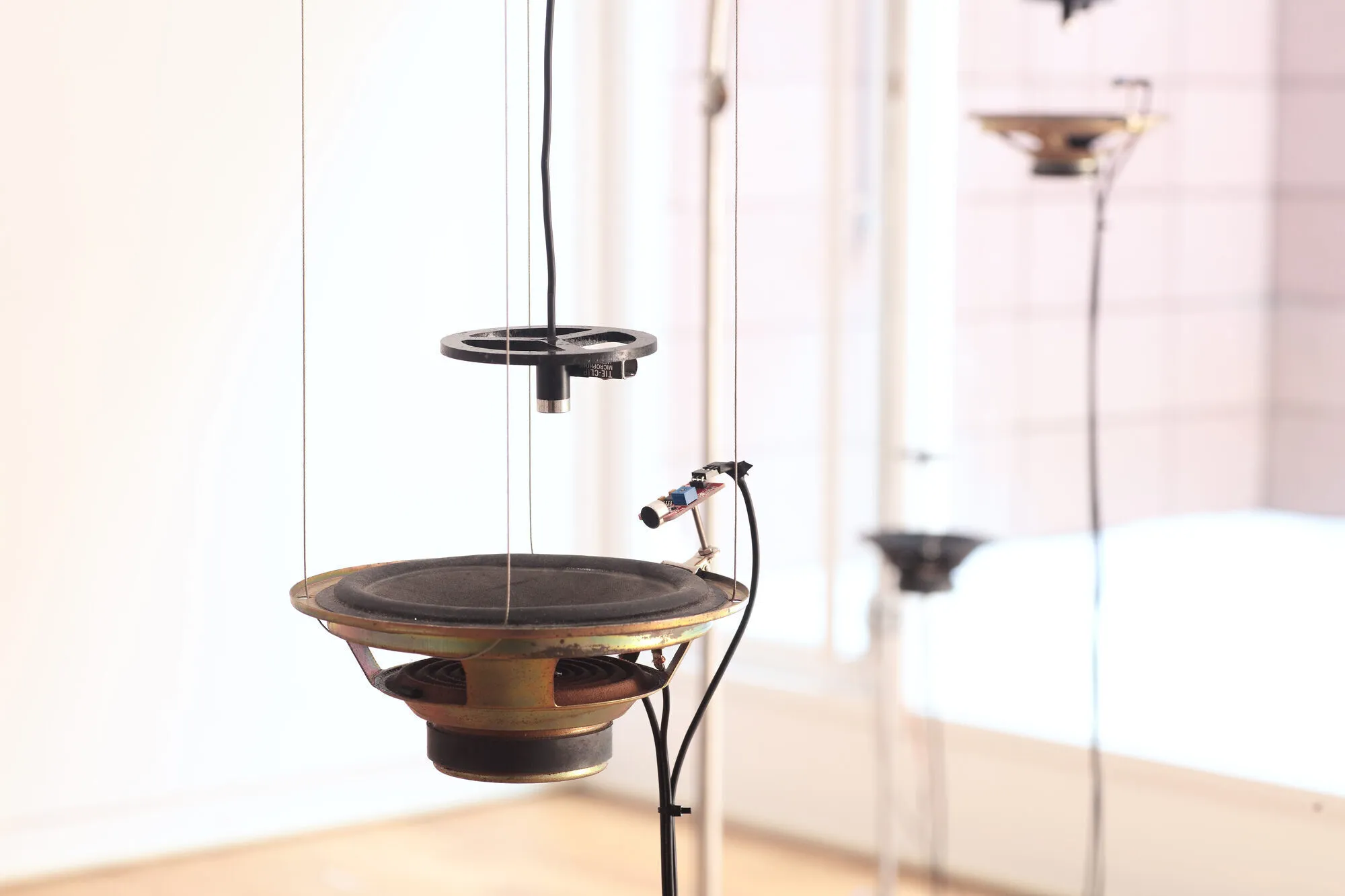
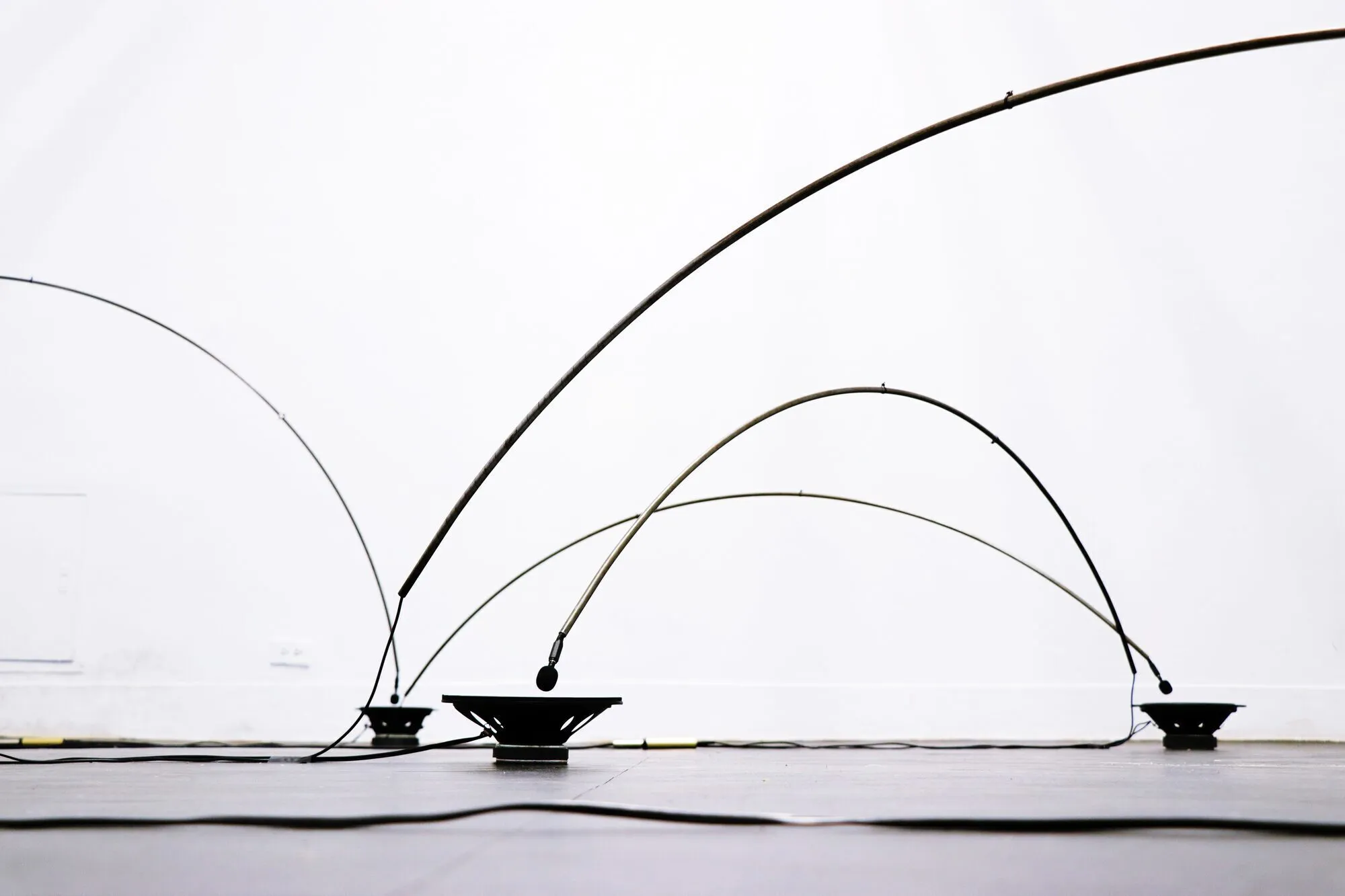
For a project-based course, I made the first version of an installation, which later became the predecessor of Feeding. Four different microphone-and-speaker pairs were suspended from structures made from metal fishing rods, without any movement or programmed control. Because each speaker had different characteristics, each tended to emphasize different frequencies. As their sounds intertwined, they formed a kind of balanced feedback state within the space. One interesting discovery was that this balance could be disturbed at any moment. Even without approaching the installation itself, an audience member simply moving through the space could alter the reflection or absorption of sound, disrupting the existing balance and causing the sound to change. However, audio feedback has long been a widely used method and form within the history of sound art. After completing this experiment, I also encountered Adam Basanta’s A Room Listening to Itself, which offered a much more developed exploration and presentation of the phenomena described above. This led me to develop a series of different experiments in the hope of finding other ways of approaching and thinking about feedback.
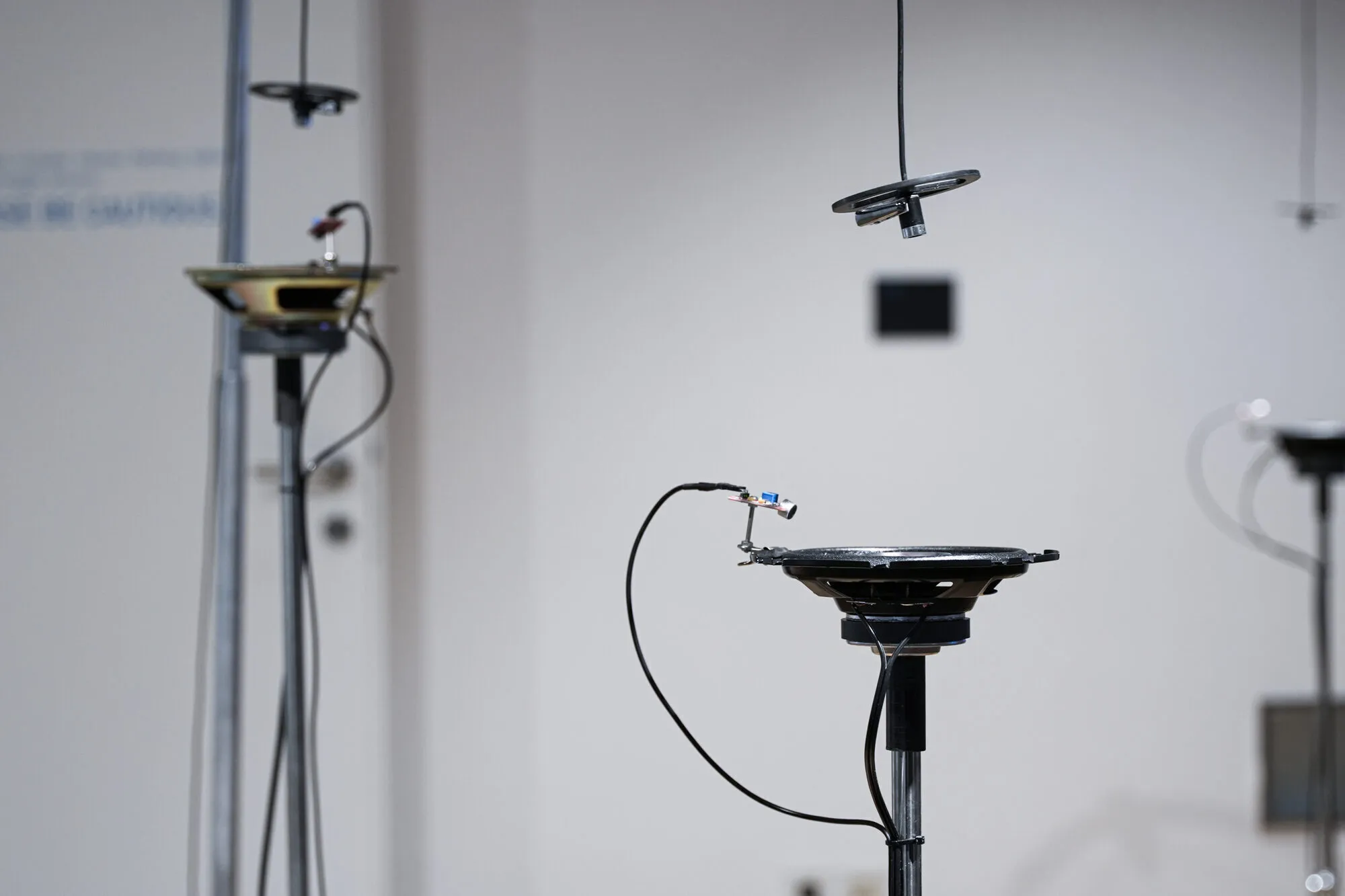
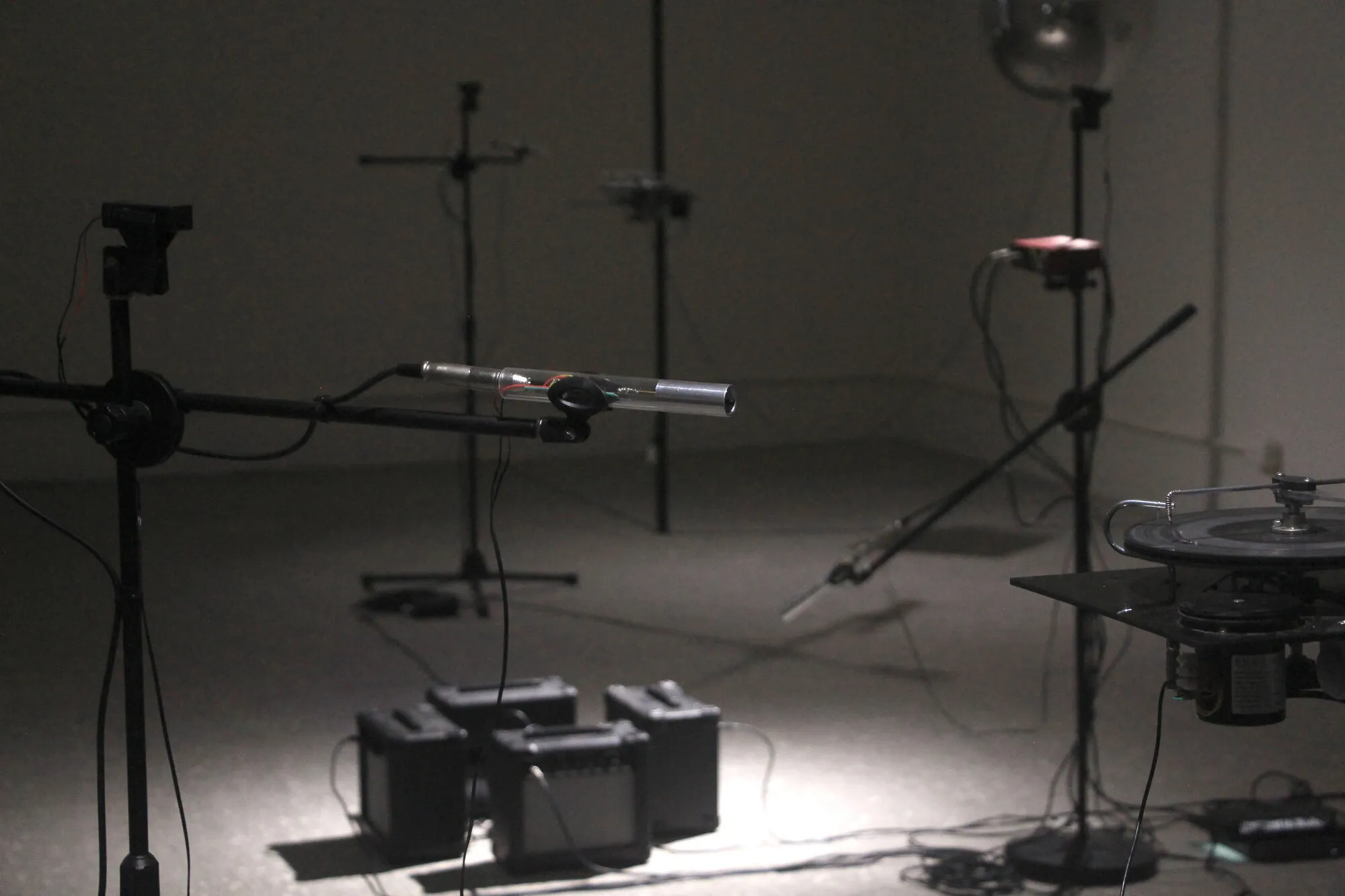
In Feeding (2020), I increased the number of units from the earlier installation and distributed them across a larger space. I also introduced simple mechanical structures and operational rules, treating the work as an emergent sound system based on sound, environment, and control. Each speaker in Feeding was equipped with a volume sensor. When the sound became too loud, the microphone was pulled upward and away from the speaker, reducing the feedback. When the sound became too quiet, the microphone was slowly lowered toward the speaker, producing stronger feedback. To me, the work seemed to demonstrate another kind of process of seeking equilibrium. The individual units appeared to converse with and probe one another, while interference from the surrounding environment further affected the physical behavior of the installation. At times, for example, simply approaching the installation could strengthen the feedback through changes in sound reflection, causing the microphone to be pulled upward.
Another work, Cross (2021), established a different set of rules based on feedback. Like a message being passed from mouth to ear, the speakers functioned as “mouths” and the microphones as “ears.” Four sets were arranged in the space: the sound from A was received and amplified by B, then received and amplified by C, then by D, before eventually returning to A, forming a continuous loop. The work was intended to observe the process through which sound becomes transformed. Since every speaker has different characteristics, none can reproduce the sound of the previous speaker with complete fidelity. As a result, even though the same sound—the subtle noise already present in the space—was repeatedly transmitted, it was not only amplified but continuously transformed in the process. Harmonics could emerge through the interaction of different frequencies, while sounds mixed through reflections in the space before entering the microphones again.
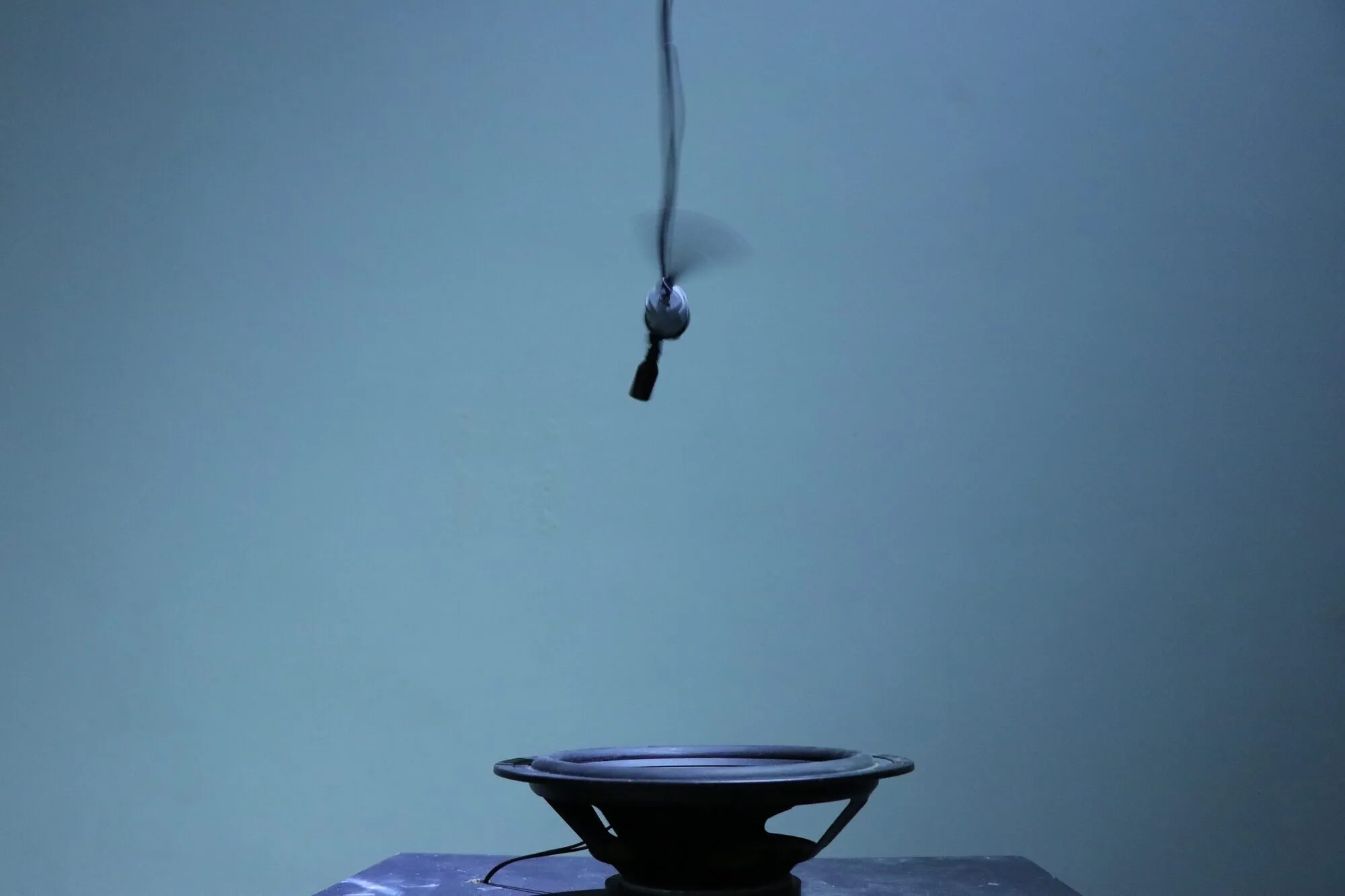
Cyberfly (2021) was another, smaller-scale experiment that attempted to introduce objects other than microphones and speakers into the feedback mechanism. I used the image of a trapped insect as the central point of imagination, combining a small motor, a single propeller blade, a counterweight, and a microphone into an interconnected mechanism suspended above a speaker. The imbalance created by the rotation caused the mechanism to twist continuously, while the microphone attached to its end constantly changed its distance and angle in relation to the speaker. This movement caused the feedback to form and fade intermittently, producing irregular low-frequency sounds that echoed the original image of the trapped insect.
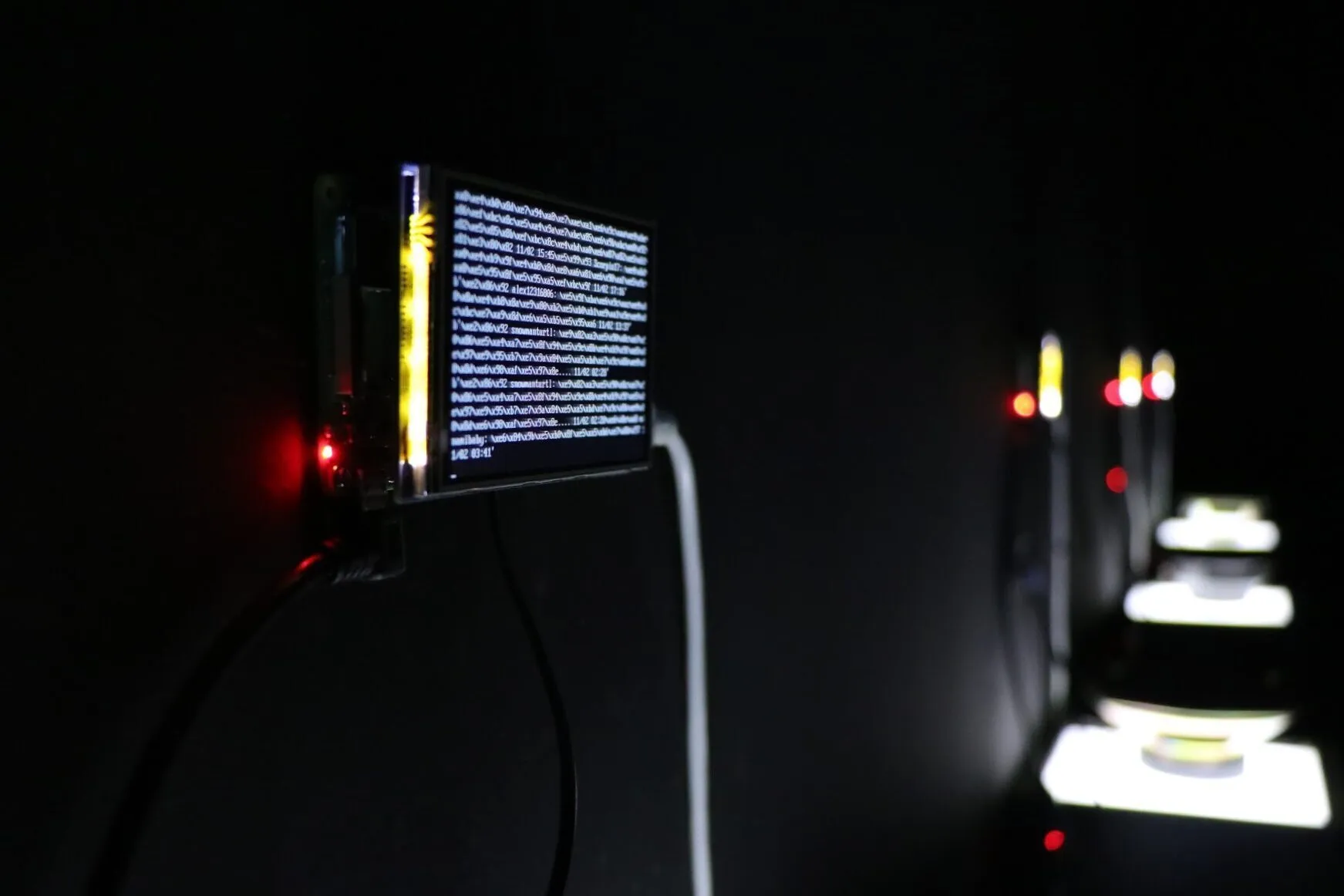
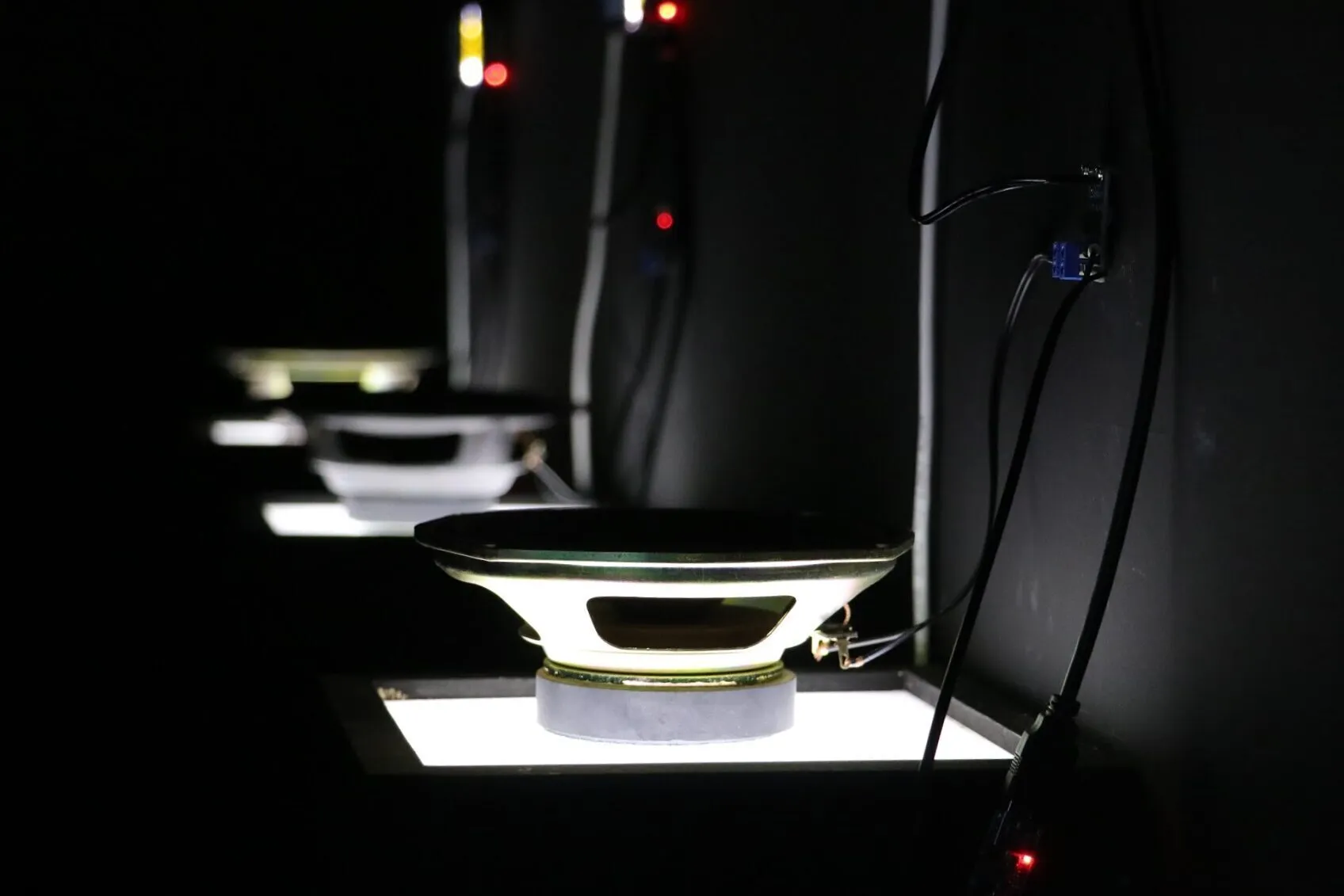
Beyond feedback, another form of noise produced by sound equipment became the starting point for 愛(2020): the turn-on/turn-off transient generated when audio equipment is powered on or off. When equipment is not switched on or off in the proper sequence, a sudden change in electrical current can travel through the amplifier to the speaker, producing a short and powerful pop. Setting aside the potential damage this may cause to the speaker, what interested me was that this sound emerges from the activity of electricity itself rather than from the audio content intended to be played. At the same time, it causes the speaker cone to make a clearly visible physical movement. This connection between electrical current, sound, and the body became the starting point for developing the work. In 愛(2020), I encoded online forum posts about relationships and love into binary signals using UTF-8, then mapped 0 to power off and 1 to power on, producing a sequence of transient pops. As emotion passes through a series of transformations—from text to code, electrical current, and finally sound—its original semantic meaning becomes unrecognizable, leaving behind only a series of mechanical pulses.
I initially grouped these experimental works under the title “Wrong Sound.” They all emerged from malfunctioning or improperly functioning sound systems, and involved reconsidering or listening to sounds that would normally be treated as something to eliminate. In my experiments with feedback, I was particularly fascinated by the fact that the mechanism does not necessarily require any externally introduced sound. Tiny vibrations already present in the space, or even noise within the amplification circuit itself, can develop into enormous feedback sounds. To me, this sensation of something emerging almost out of nothing felt magical, although it also made these works relatively self-contained in terms of their source.
With 愛(2020), I began to shift my attention toward the source that drives a work, as well as the relationship between control and indeterminacy within it. Indeterminacy has since become an essential element in my practice. I like a work to exist as something continuously unfolding and open to external interference. Rather than being bound to a predetermined outcome, it can continue to change throughout its process, and I believe this allows the work to retain a certain degree of agency. This does not mean, however, that the work is free from the artist’s control. I still inevitably determine where control is exercised and to what extent. How these two forces are balanced is also closely connected to how the source is allowed to manifest itself within the work.
The System If “noise” is taken out of the equation, these early practices seem to revolve around another, more fundamental method: the “system.” For me, the core of these works lies in the construction of mechanisms and in how I think about the source. Rather than imagining the final sonic result, I tend to begin by establishing relationships between objects and defining the rules through which they interact. Only afterward do I consider how these relationships are actually experienced through space and sound. Although “sound” has gradually ceased to be the first element I consider, I still prefer it as the final form through which the work is presented. One reason is that, when I think about how to construct a system, sound can preserve the original variations of a signal relatively directly. Another is that its inherent physical properties provide a strongly spatial and penetrative experience, one that can even act directly upon the body. In addition, as a time-based art form, sound can function as a record, a sequence of events, or an ongoing process.
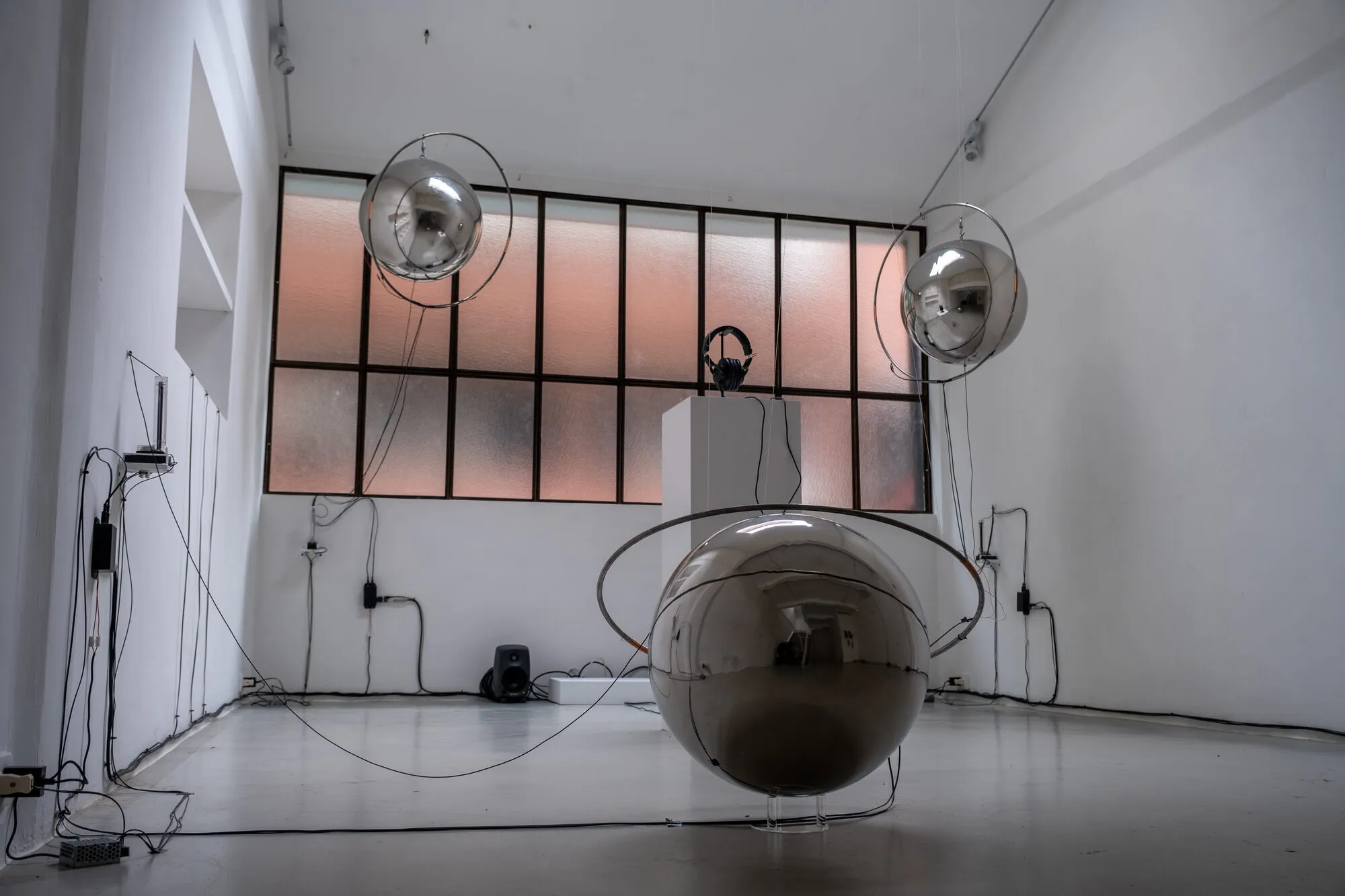
My university graduation work, Soul (2022), began with associations between electrons, randomness, and consciousness. At the time, I was particularly interested in interpretations of measurement, uncertainty, and superposition in quantum mechanics: before measurement, the state of a particle can only be described in terms of probability, while measurement produces a definite outcome. This led me to wonder whether choices or behaviors that appear conscious in the reality we inhabit might also be understood as forms of contingency—as outcomes emerging from interactions between randomness and randomness. From this line of thought, I constructed a mechanism to observe how electromagnetic signals, operating within a specific set of rules, might “choose” how a piece of music unfolds. In the work, an electrostatic device consisting of a generator and metal spheres creates what I imagined as an invisible field of attraction within the space. Signals from electromagnetic activity are picked up by inductive devices placed nearby and sent into a program, where the musical structure of Soul music provides a framework within which different chords and rhythms are triggered at random.
I like to begin with real phenomena and mechanisms and extend them through speculative and sometimes imaginative associations, but I do not intend for the work to enter into discussions of spirituality or the supernatural. Here, Soul does not refer to the existence or non-existence of a “soul.” On one hand, the title refers to the Soul music on which the work draws; on the other, it preserves a hypothesis based on a “What if?”: if we temporarily imagine the random activity of electrons as a form of “choice,” what might we perceive in the results produced by such a system?
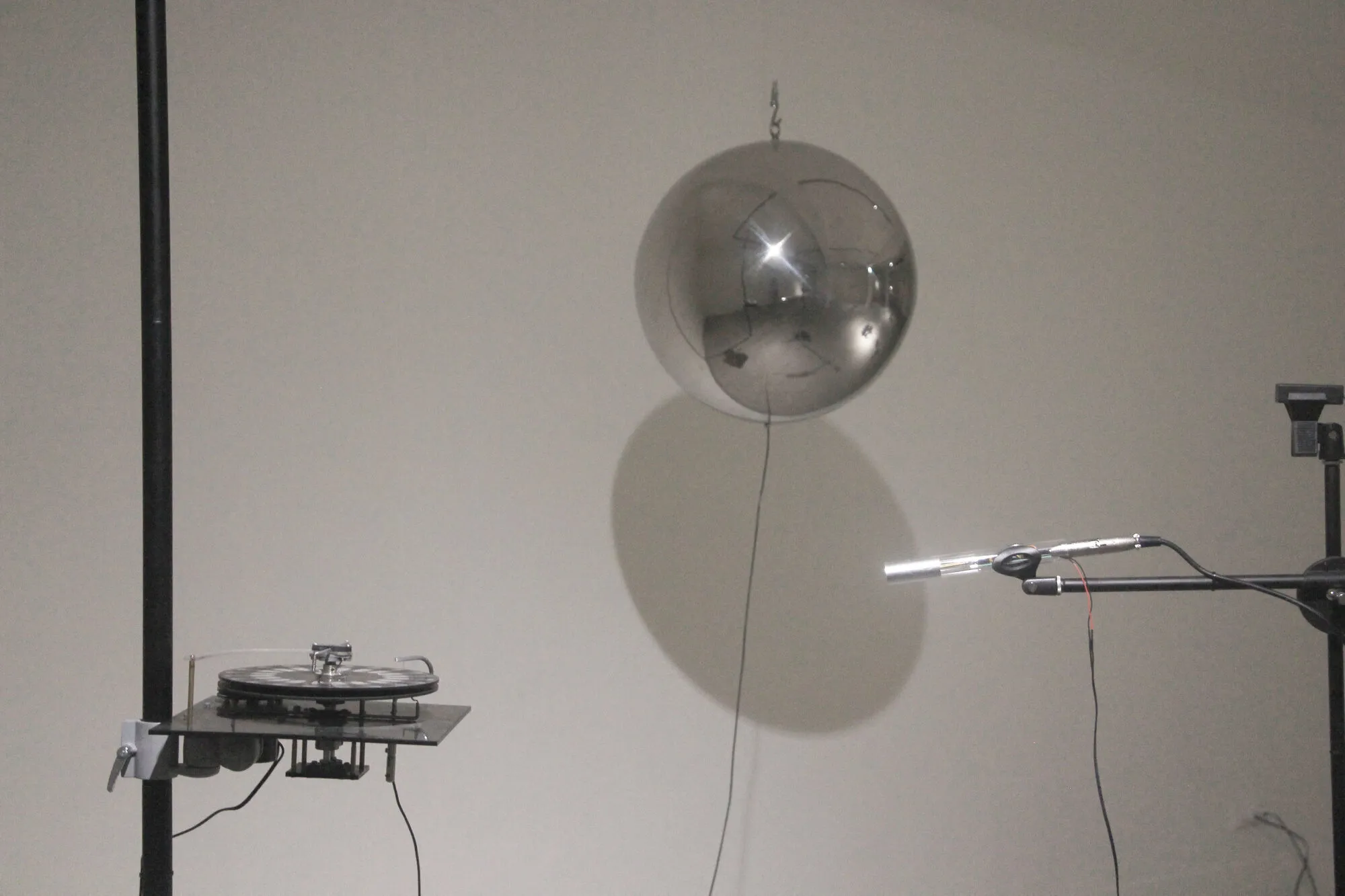
Later, an opportunity to exhibit the work at a sound art festival led to a new version. I tend to remove objects that have no functional role or are merely decorative, while also considering how the functional components that remain might carry certain symbolic meanings or associations. In this revised version, Soul-vinyl (2023), I removed the headphones from the previous version, which played modulated electromagnetic signals, as well as the small light bulbs, which had previously been used both to connect the work with another piece and to provide a direct visual indication of electromagnetic activity. In terms of sound, I retained only the instruments and a small portion of the original signal.
I also replaced the Van de Graaff generator with a Wimshurst machine and redesigned it to resemble a turntable, while the inductive pickup, which had previously resembled a loop antenna, was redesigned to look like a recording microphone. The work retained its original operational logic, but through these changes I tried to make every necessary component participate simultaneously in constructing the concept of the work. The turntable is both an electrostatic generator and a reference to a medium for playing music; the microphone is both an inductive device that receives electromagnetic signals and an object that evokes the acts of listening and recording.
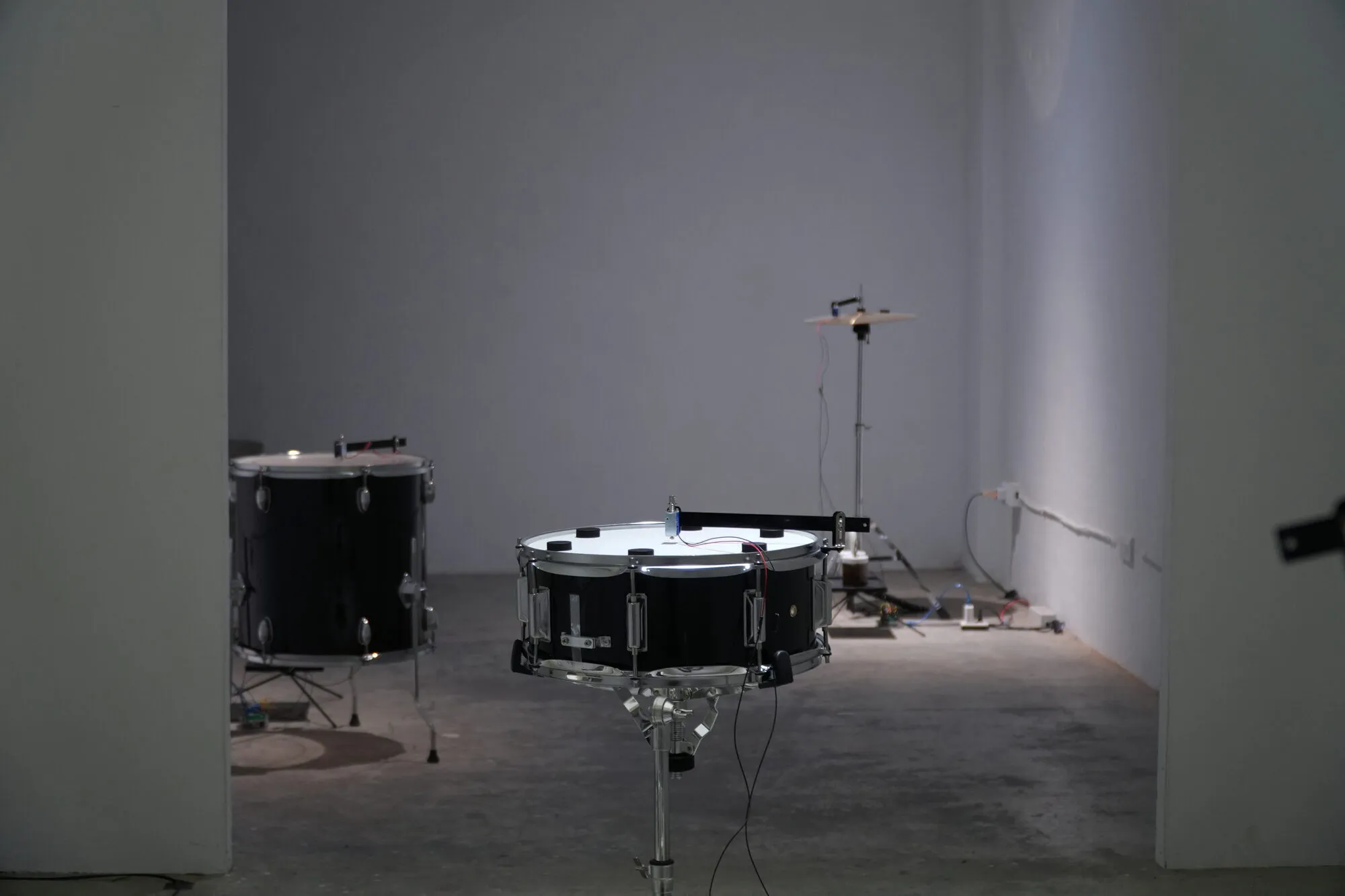
Microbial Ensemble (2025), presented in my 2025 solo exhibition, began with the geographical context of Wanhua, where the exhibition space was located. The director of the space introduced me to the history of the area, which was once known as “Gar-á-á,” a name said to derive from the transliteration of the Ketagalan word “gara,” meaning “swamp.” As the city developed, the original landscape was gradually filled in and covered over, eventually becoming the urban area it is today. I began to think of wetland sediment as a kind of accumulation of memory, where materials and traces of life from different periods become mixed together. Even as the appearance of the surface changes, the nutrients and energy accumulated within it may continue to sustain forms of biological activity invisible to the naked eye.
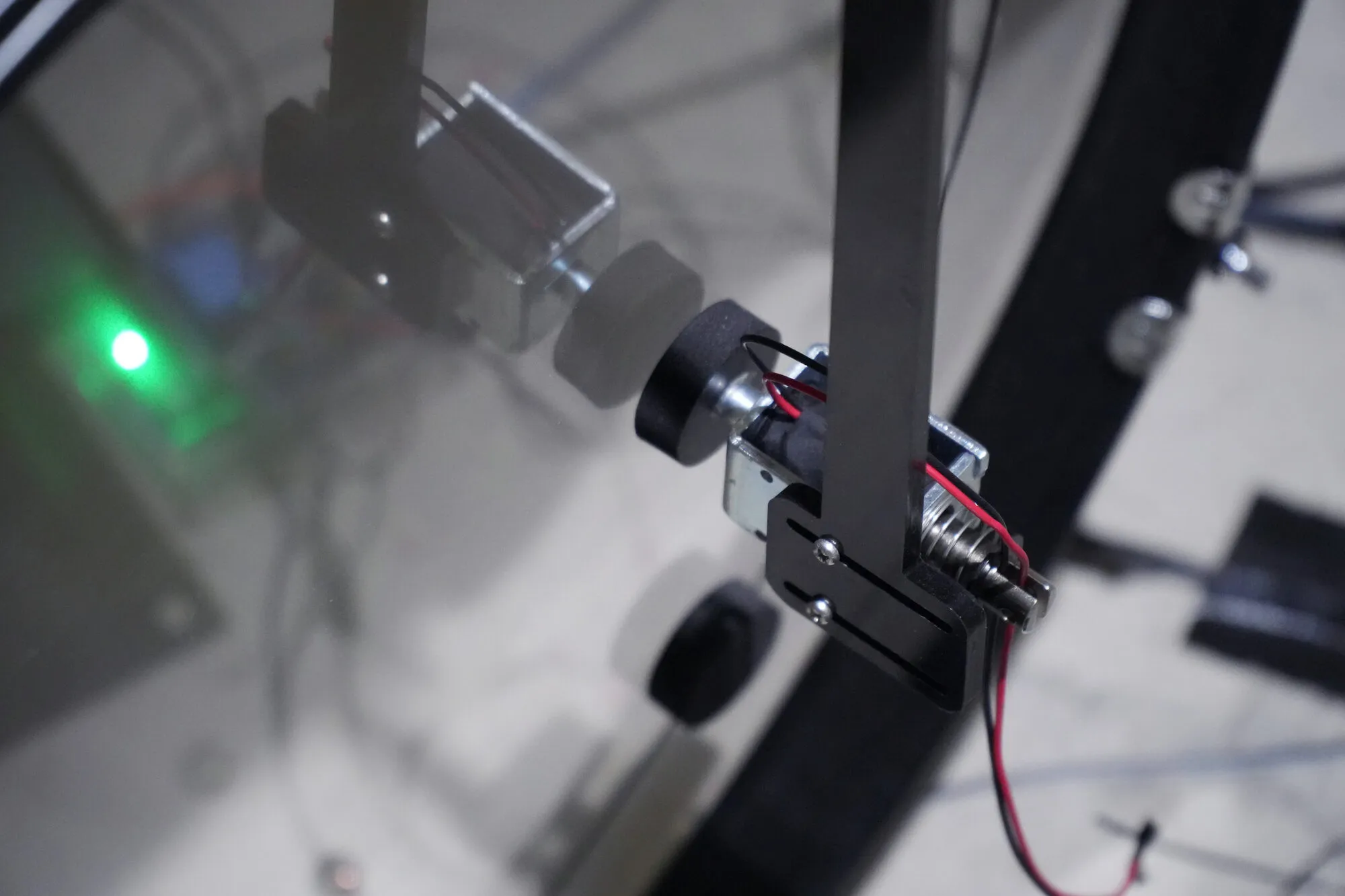
For this work, I collected soil from a nearby wetland and used the principles of a microbial fuel cell (MFC) to detect weak electrical signals generated through microbial metabolic activity. I treated these signals as a form of accumulated energy: once they crossed a certain threshold, an event was triggered, activating electromagnets that struck a set of drums. Returning to my thinking about the “system,” each physical impact clearly points back to biological activity, making the relationship between source and event perceptible. Yet the condition that determines whether the event occurs—the numerical value of the threshold—remains hidden within the system, quietly leaving a trace of the artist’s control.
I have come to think that this kind of selection may be just as important as the indeterminacy discussed earlier. Indeterminacy allows the work to produce changes that cannot be fully anticipated, while constraints allow those changes to be organized and experienced. Constructing a system may therefore be a process of continually adjusting between the two: leaving enough space for the source to determine what happens, while using rules to allow these activities to take form as a work.
Since 2020, I have moved from making sound the primary medium of my practice, to recognizing the importance of the mechanisms behind it, introducing other sources, and eventually reconsidering the relationship of control within a system. These works have built upon and extended one another, gradually forming a set of fundamental methods in my practice. From an initial focus on the physical phenomena of sound and space to Microbial Ensemble, which began to engage with land, history, and ecology, I have also found the range of sources within my work gradually expanding.
I think the reason I work in this way probably has something to do with how much I loved magic as a child. To me, establishing rules is actually a lot like developing magic. Once there is an impulse to create something, I begin by thinking about and choosing the materials, then developing the spells or formations that allow these materials to act upon one another. Eventually, a magical effect appears: perhaps a gust of wind, a ball of fire, or a sudden explosion of sound... Going forward, I hope to continue exploring different ways of constructing sound, while thinking more deeply about how the choice of source and the rules I establish can extend the subjects I want to address—and even whether this kind of magic, beyond producing sound and perceptual experiences, might also have some effect on the reality in which we live.
序 大學初期我的創作並沒有一個明確的目標及方向,多數時間僅遊走在技術的探索之中,雖然也希望能夠將思想附加於作品之上,但以我當時的手法來說充其量只像是一種象徵式的表現或一則想法的附圖。我發覺一開始之所以會像無頭蒼蠅一樣可能是源自於過多的可能性,因此之後我開始以限制自己的方法來發展作品,例如當時我受聲音藝術的實驗性以及其現場性所吸引,我便試著限制自己只能以聲音為主體創作,雖然說起初是一種限制,但這也使我慢慢地發掘深入研究一項媒材的有趣之處。
Wrong Sound 在某次表演專案中我大量使用到麥克風與音響設備,時常需要克服聲音回受(Feedback)相關的問題,而在解決的過程中我也發現到這種聲音的一些有趣的特性。首先是它的機制:麥克風接收到的細微聲響被喇叭放大,再次被麥克風接收,接著放大。如同自己聆聽自己並在過程中不斷改變自己的狀態一般,它天然具有非常直接的反身性,且在有機物理世界中實際聽到的回受聲響居然是漸漸接近像是單一頻率的正弦波,非常不像是喇叭應該發出的聲音。藉著一次專題課我嘗試做了第一個版本的裝置(Feeding的前身),它以金屬釣竿的造型懸掛著四組不同的麥克風與喇叭,沒有動態也沒有任何程式控制,因為喇叭各異他們所著重被放大的頻率也不同,聲音彼此交纏後在空間形成某種平衡的回受聲響,一個有趣的發現是這個平衡隨時都會被干擾,就算觀眾沒有接近裝置,只要在空間中游走就可能成為聲音反射或吸收的因素而改變原有的平衡使聲音產生變化。然而聲音回受在聲音藝術的歷史中早已是非常普及的方法及形式,在完成這個實驗後我更發現 Adam Basanta 的 A Room Listening to Itself 已經對上述的現象有更為完整的討論及呈現,於是我開始嘗試發展一些不同的實驗,也希望能找出不同的思考角度。
在 Feeding (2020) 中我新增了原本裝置的單元數量放置於更寬廣的空間,加上簡單的機械結構及運作規則,將其視為一種奠基於聲響、環境與控制的衍生聲音系統。在Feeding中每個喇叭上有一個音量感測器,當聲音過大的時候麥克風會被往上拉遠離喇叭使回受變小,聲音過小時麥克風會被慢慢往下降接近喇叭產生較強的回受。對我而言他似乎表現出了另一種尋找平衡的狀態,單元間彼此會互相對話及試探,外界環境對聲音的干擾也會進一步影響到裝置的動態,例如有時候只要有人靠近裝置(因為聲音反射變快回受變強)麥克風就被往上拉。
另一件作品 Cross (2021) 則在Feedback這個基礎上建立了另一個規則,像是口耳相傳一般,喇叭作為「口」麥克風作為「耳」,空間中共有四組,A的聲音被B接收、擴大再被C接收、擴大再被D接收、擴大再回到A,如此循環反覆。這件作品旨在觀察聲音變形的過程,因為每一個喇叭單體都是不同的,他們勢必無法忠實呈現上一組喇叭的聲音,這樣一來儘管同一個聲音(空間中微小的雜訊)被不斷重複傳遞,除了放大外這個聲音也會在傳遞的過程中不斷變化,甚至在彼此的頻率中產生諧波,並且在空間的反射中混合又進入麥克風。
Cyberfly (2021) 則是另一項較為小品的實驗,試圖在回受的機制中加入喇叭與麥克風之外的其他物件,我以一隻受困的蟲作為主要想像,將小型馬達、單片螺旋槳、配重與麥克風組合成一個有連動關係的裝置懸吊於喇叭上方,旋轉造成的不平衡使其不斷扭動,尾端連接的麥克風也因此持續改變與喇叭之間的距離和角度。這樣的運動使回授時而形成時而消退,產生不固定的低頻聲響,回應到原本關於蟲的想像。
關於音響設備的噪音除了Feedback之外,作品 愛 (2020) 則是從音響開關機時產生的瞬間訊號(turn-on/turn-off transient)出發,當設備沒有依照正確的順序開關機時,瞬間的電流變化可能經由擴大器傳送至喇叭,形成短促而強烈的爆裂聲(pop)。撇除掉他可能對喇叭造成的傷害,這種聲音發生於單純的「電」的活動而非準備被播放的音訊內容,同時它也會讓喇叭的震膜產生明顯的跳動,這種介於電流、聲音與身體之間的聯想成為了作品發展的途徑。在 愛 (2020) 中我將網路論壇與感情有關的文章以UTF-8編碼成二進制的訊號,再將此訊號的0對應到斷電,1對應到通電,使其產生一連串突波的聲響。當情感經過文字、編碼、電流與聲音的一連串轉換,原本的語意將無法被辨識,最後只剩下機械式的跳動。
早期我將這些實驗作品統稱為「錯誤的聲音(Wrong Sound)」他們都來自失能的聲音系統,關於重新觀看或聆聽需要被排除的聲響。在Feedback相關的實驗中我一直覺得回受機制中還有一個有趣的點是它可以不需要有外部加入的聲音,從空間中微小的震動或甚至擴大電路中的雜訊開始都能夠形成巨大的回受聲響,我覺得那種接近無中生有的感覺像魔法一樣神奇,但這也使得那些作品稍微比較純粹。在 愛 (2020) 我將思考轉向作品的驅動來源(source),以及作品中的控制與不確定性。不確定性是我的作品中不可或缺的重要元素,我喜歡作品是一個持續發生且容許外部干擾的存在,它不需要受制於預先決定的結果,而是能在過程中不斷變化,我認為這樣的方法可以使作品保有一定程度的能動性。但這不代表作品擺脫了作者控制,我還是無可避免地決定了控制位置或程度,如何調配兩者也往往牽扯到來源(source)要如何在作品中顯現。
The System 如果將「噪音」拿掉,前期這些實踐似乎還圍繞著另一項更為基本的方法就是「系統」,對我而言這些作品的核心想法其實是發生在機制的建立以及我如何思考來源(source),比起想像最後聲音的結果我更傾向先建立作品中物件與物件的關係、彼此互動的規則最後才是他們實際上如何透過空間及聲響被感受。儘管「聲音」已經漸漸不是作為第一被考量的元素,我還是喜歡以其作為最終呈現,一來是因為在我思考如何建構系統時聲音可以相對直接地保留訊號原本的變化,另外則是它天然的物理特性提供了一種非常具有空間感、穿透性甚至能直接作用於身體的感受。除此之外,聲音作為一種時間性的藝術形式它也可以是一種紀錄、一連串事件或是一個持續的過程。
大學畢業作品 Soul (2022) 從電子、隨機與意識的聯想出發,當時我對量子力學中測量、不確定性與疊加態的詮釋非常感興趣:一個粒子的狀態在測量以前只能以機率描述,在觀測後得到某一固定結果。而在我們所處的現實中那些看似有意識的選擇或行為會不會其實只是一種偶然,一種隨機與隨機交互作用下的結果?從這樣的思考出發,我建立了一套機制來觀察電磁訊號在特定規則下會怎麼選擇音樂如何進行。作品中的起電機與金屬球組成的靜電裝置為空間創造無形的引力場,電磁活動的訊號透過他們附近的電感裝置接收後被送進程式中,並以靈魂樂(Soul)曲式作為框架隨機觸發不同的和弦及節奏。我喜歡從真實的現象與機制出發進行一些天馬行空的想像與延伸,但並不希望作品因此進入對靈性或超自然的討論,所以這裡的Soul 並不是在指涉某種存在或不存在的「靈魂」,而是一方面呼應作品所取材的靈魂樂(Soul),另一方面則保留一個基於「What if?」的假設:如果我們暫時把電子的隨機活動想像成一種「選擇」,那麼我們可以從這套系統最後產生的結果感受到什麼?
後來隨著一次聲響藝術節的展出機會這件作品也迎來了一次版本的更新,因為我習慣盡量去除作品中沒有功能的或是裝飾性的物件,也思考怎麼讓原有功能性裝置承擔一定的符號或意義。因此在這次改版 Soul-vinyl (2023) 中我移除了上一個版本的耳機(裡面的聲音是調變後的電磁波聲響)以及小燈珠(上一個版本中是為了跟另一件作品連動以及直接呈現電磁波),聲音的部分只保留樂器以及一小部分的原始訊號。並將起電機從范式起電機(Van de Graaff generator)換成韋氏起電機(Wimshurst machine)的形式並做成像是唱盤一樣,原本像環形天線的電感則改制成像是收音麥克風一樣。作品還是保有原本的運作邏輯,但我試著透過這些改動讓每一個必要的物件同時參與概念的建立,唱盤既是產生靜電的起電機也指向音樂播放的媒介,麥克風既是接收電磁訊號的電感,也產生聆聽與收音的意象。
2025個展中的 Microbial Ensemble (2025) 從展場的地理位置萬華開始,空間負責人和我介紹了萬華的歷史,曾經叫做「加蚋仔」源自凱達格蘭族語「gara」音譯,意指「沼澤地」,隨著城市發展,原本的地貌逐漸被填平覆蓋成為今日的城鎮。濕地的泥沙像是一種記憶的沉積,它混合了不同時期的物質與生命的殘跡,即使地表的樣貌已經改變,其中累積的養分及能量仍可能讓肉眼不可見的生命活動持續進行。這件作品中我搜集了附近濕地的泥土,利用微生物電池MFC的原理偵測其代謝活動產生的微弱電訊號,將其視為某種能量的累積,在突破某個閾值後產生事件,觸發裝置的電磁鐵敲擊鼓組。回到我對「系統」的思考,物理撞擊的發生明確指向了生物活動,來源與事件的關係清晰可見,然而使其發生的條件(threshold的數值是多少)卻隱藏在系統內部,悄悄留下了作者的控制痕跡。我認為這樣的篩選也許和前面所述的不確定性同等重要,不確定性讓作品能夠產生無法預期的變化,而限制則讓這些變化得以被組織與感受。建立系統也許正是在兩者之間反覆調整,同時留下足夠的空間讓來源決定,同時透過規則使這些活動形成作品。
從2020開始以聲音為主體創作,接著注意到背後機制對我創作的重要性,並開始引入其他來源,到重新思考系統的控制關係。這些作品承先啟後地接續並延展了我的實踐,也一步步成為我創作的一套基礎方法。從原本關注空間與聲音的物理現象,到 Microbial Ensemble 開始面對土地、歷史與生態,我也發現來源的範圍正在慢慢擴大。
我想我會以這樣的方式創作大概是跟我小時候喜歡魔法有關吧!對我來說建立規則其實很像是在研發魔法,在有一個創造的動機後要開始思考並選擇材料,然後研發咒語或陣型來使這些材料之間發生作用,接著就會出現魔法的效果,可能是一陣風、一團火球、一聲巨響......。接下來期待能夠繼續探索更多聲音建構的方法,以及更深入思考source的選擇與規則可以如何延展我想討論的主題,甚至這樣的魔法除了產生聲音與感知經驗外,是否也可能對我們所處的現實產生某種影響?